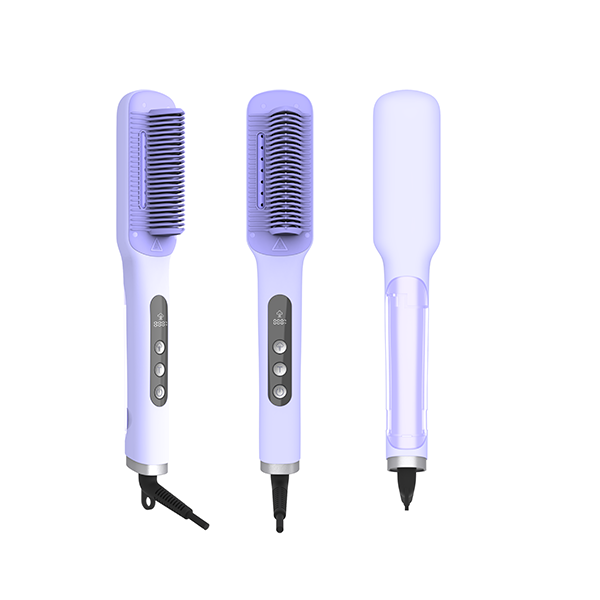
1. The Shortcut Nobody Talks About
Here's a truth most people in beauty distribution learn the expensive way: launching a hair styling brand was never really about the product idea. It's about getting something that actually works, carrying your name, at a price that leaves you a margin after freight, tariffs, and the marketplace's cut.
You can spend two years and a small fortune engineering your own straightener from scratch. You can also roll the dice on unbranded imports and hope your customers don't notice the cheap plastic. Or — and this is the option more smart buyers keep quiet about — you can take a product that's already been built, tested, and shipped thousands of times, and make it yours.
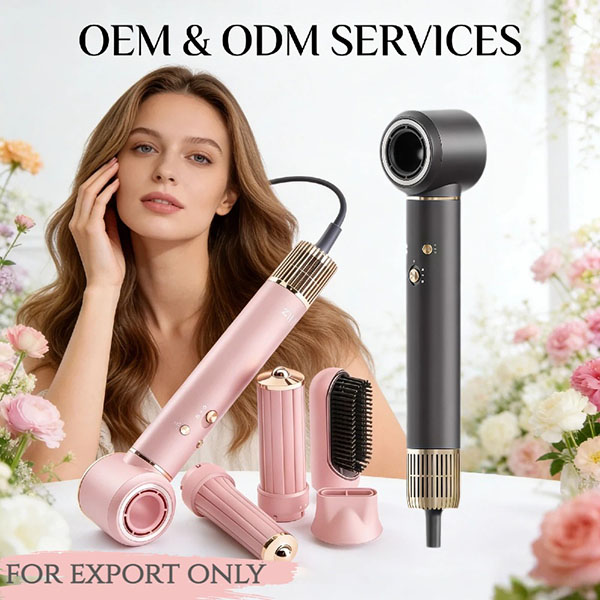
That's private label hair styling tools in a nutshell. The hard engineering is done. You bring the brand, the colors, the packaging, the market. Somebody else handles the part where products catch fire in testing or fail after a hundred uses.
Baiyisen Technology has been on the manufacturing side of that equation since 2016. The team behind it carries over 15 years of experience in personal care appliances, which is another way of saying: the models in our catalog have been through real production runs, not just renderings.
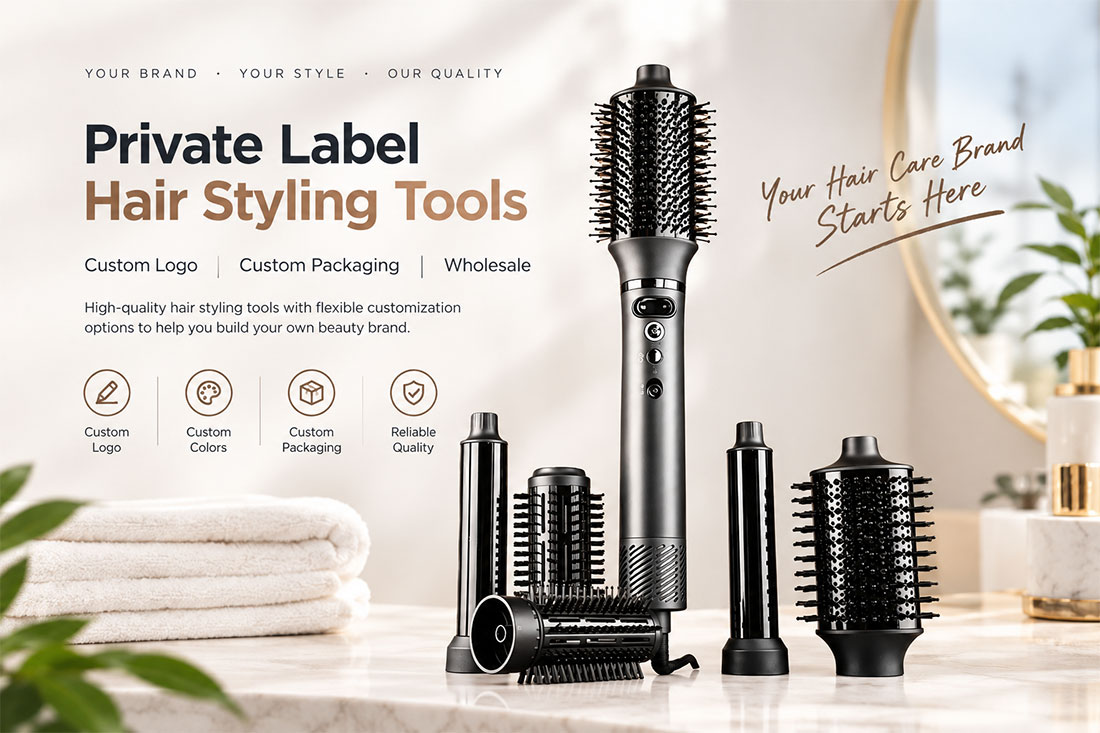
2. The Product Line You Can Actually Build On
Let's walk through what's on the table, in the way you'd actually weigh it as a buyer — not as a category list, but as decisions.
2.1 Straighteners
2.2 Curling Tools
Curling irons and wands look similar on a shelf and behave very differently. Barrel size is the whole game — a tight barrel makes tight curls, a wider one makes loose waves, and your customer's satisfaction lives or dies on that match. Whether the tool clamps or not (iron vs. wand) splits your audience again. Beginners want simple; salons want precision and multiple barrel options. Pick a lane before you pick a model.
2.3 Dryers
The gap between a $15 travel dryer and a $200 high-speed professional unit is enormous, and both are legitimate products. For a first order, a dependable everyday dryer with a few heat and speed settings is about as low-risk as this industry gets. But if differentiation matters to you, look hard at high-speed brushless dryers — they're noticeably lighter and faster, and customers can feel the difference in the first thirty seconds. That feeling is what justifies a premium price.
2.4 Hot Air Brushes
This category sells on one sentence: dry, smooth, and style in a single pass, no juggling a dryer and a round brush. It's a story that films beautifully and demos instantly, which is why e-commerce sellers keep building entire listings around it. If your channel is Amazon or social video, this deserves a serious look.
2.5 Multi-Functional Stylers
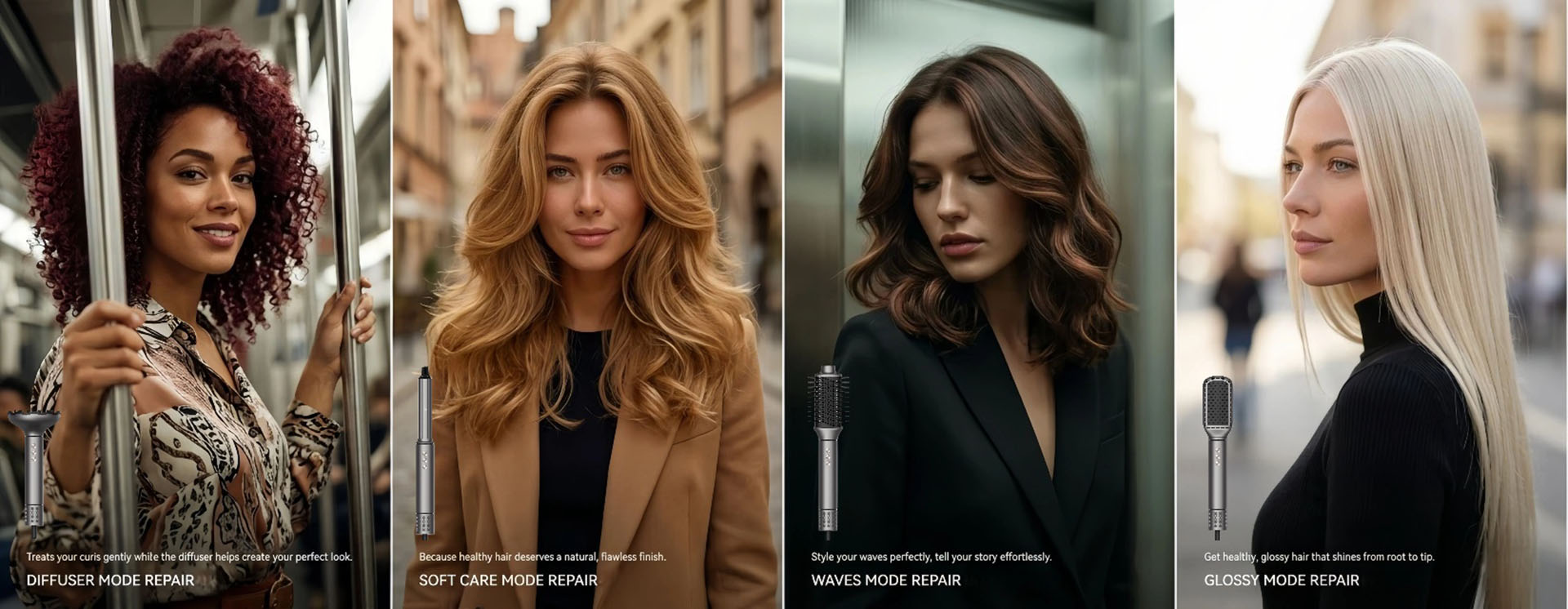
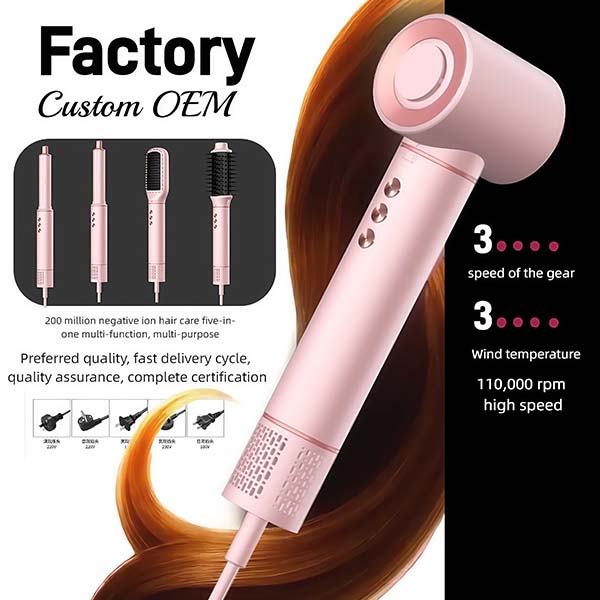
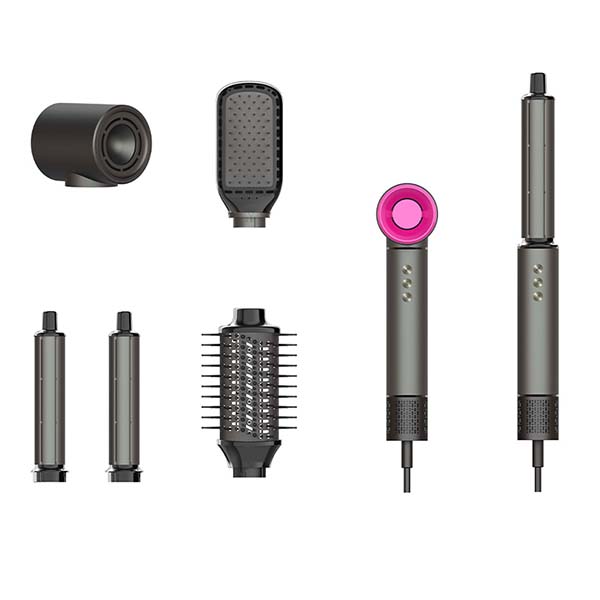
These fold drying, straightening, curling, and volumizing into one body with swappable attachments — several tools for the price of one, which is an easy upsell. Just don't assume all stylers are created equal. Specs and customization options vary a lot between models, so treat each one as its own evaluation, not as a uniform category.
3. Customization: What's Real and What'll Cost You
This is why you're going private label, so let's talk plainly.
3.1 Your Logo
Where the logo lands depends on the surface. Printed logos suit some models; laser marking or engraving suits others; a handful of digital products can show a startup screen logo. It's not one-size-fits-all. Confirm the method for the specific model before you order, not after.
3.2 Color
Brand colors on the product itself? Often doable. The catch is that custom colors usually carry a higher minimum than standard ones, and feasibility depends on the model and what's on the production schedule. Get the MOQ number before you commit to a shade.
3.3 Packaging
This is where your brand finally becomes real to a customer. Custom color boxes, inserts, manuals, labels, and barcodes can all carry your identity — and on Amazon, the packaging is part of the experience people remember. Treat it as a product decision, not a formality.
3.4 Specs and Accessories
Voltage, plug type, temperature settings, cable design, and what's in the box can often be adjusted. All of it depends on the model and what's technically possible. Write it down, get it confirmed, and don't leave it to assumptions.
4. Match the Product to the Person Actually Buying It
Everything downstream of this one decision gets easier once you're clear on who's paying.
A brand launching its first line wants a single hero product it can explain in one sentence. A distributor feeding retail stores wants steady, boring, proven sellers. An Amazon seller wants products that demonstrate well and review well. A retailer chasing shelf presence cares more about color and packaging than internal specs. A salon account cares about heat control, durability, and surviving daily use.
Then there's the unglamorous checklist nobody enjoys: voltage and plug for your market, the retail price you need to survive on, packaging expectations, and the safety regs that apply where you sell.
One honest piece of advice: resist the urge to launch a big catalog. Start with two or three models you understand completely. It stocks easier, markets easier, and keeps quality consistent — and you'll learn more from ten orders of one product than from one order of ten.
5. MOQ, Price, and Lead Time, Straight Up
These three questions come up on every single first inquiry. Here are the answers without the runaround.
5.1 MOQ
It depends on the model and how much you customize — that's the honest version. Standard single-color products at Baiyisen start from 1,000 units. That's low enough that an emerging brand can genuinely consider it, not just a multinational.
5.2 Price
Think of wholesale price as a stack of inputs: specs, order volume, materials, packaging, customization, and shipping. More volume and a standard config push the per-unit number down. Heavily customized small runs cost more per piece. It's arithmetic, not magic.
5.3 Lead Time
Production time is really a chain: sample approval, artwork sign-off, production planning, inspection, then shipping prep. The faster you lock samples and artwork, the smoother everything downstream goes. And get real dates for your order — don't assume last year's timeline still applies.
5.4 De-Risking a First Order
Do the unexciting things: check the sample, put every spec in writing, review the certifications, sign off on packaging artwork before mass production. A little front-loaded care prevents a very expensive surprise later.
6. Private Label vs. OEM vs. ODM
|
Factor
|
Private Label
|
OEM
|
ODM
|
|
Starting point
|
Existing products
|
Your specifications
|
Supplier's design ability
|
|
Branding
|
Yours, on a proven product
|
Yours, on agreed specs
|
Yours, with possible redesign
|
|
Development work
|
Minimal
|
Depends on project
|
Depends on scope
|
|
Up-front cost
|
Usually lowest
|
Varies
|
Varies, can climb
|
|
Best for
|
Fast launches, wholesale brands
|
Specific product requirements
|
Real differentiation
|
If branding, packaging, and speed matter more to you than inventing a new product, private label is usually the right first step. Less capital tied up, faster to market, and the product is still clearly yours.
7. What to Check Before You Trust a Factory
Unit price is the worst possible yardstick for choosing a manufacturer. Here's what to actually dig into.
Sample vs. bulk consistency. Check heating performance, temperature control, durability, electrical safety — and then verify that what ships actually matches what you approved. A flawless sample that degrades in production is a liability.
The real quality process. Ask about capacity, inspection stages, defect handling, and how orders get scheduled. A supplier who shows you the process earns more trust than one who just claims to be quality-focused.
Customization honesty. Confirm logo methods, color options, packaging services, and the MOQ tied to each. Nobody wants to find out mid-order that their chosen color isn't possible.
Compliance paperwork. Verify the certificates and test reports for your destination market and the exact model. For reference, Baiyisen carries CE, RoHS, FCC, UL, and CB — covering Europe, the US, the UK, Japan, and other key markets.
Communication and after-sales. Nail down quotation details, warranty, spare parts, and what actually happens when a quality problem surfaces after shipment.
Judge on fit, quality, responsiveness, and total cost of the whole order. The cheapest unit price is rarely the cheapest order.
Baiyisen Technology has manufactured beauty and personal care appliances since 2016. The range covers what most private label lines are built from: straighteners, curling irons, hair dryers, hot air brushes, and multi-functional stylers.
The capacity is concrete. A 15,000㎡ facility runs six production lines with twelve machines, backed by a 5,000㎡ warehouse that keeps stock ready and fulfillment moving. Materials span ABS, PC, aluminum alloy, and PA66+GF30%, and the engineering team handles material selection, structural design, electronic integration, and manufacturing optimization in-house.
The export record speaks for itself: more than 70 countries across Europe, Asia, North America, South America, and the Middle East, with CE, RoHS, FCC, UL, and CB certifications. For private label buyers specifically, we handle custom logos, colors, and retail packaging, and the workflow — samples, artwork confirmation, responsive export support — is built around overseas wholesale orders.
9. What a Private Label Order Actually Looks Like
You don't need a purchase order to get started. It usually unfolds like this:
-
Choose the category and model that fits your market.
-
Share your target market and rough order quantity — it shapes the quote more than anything.
-
Confirm the logo, color, and packaging options for that model.
-
Request a quotation and samples so you can judge quality firsthand.
-
Review specs and approve packaging artwork.
-
Confirm order, schedule, and quality requirements.
-
Arrange final inspection and shipment.
The more complete your brief — model, quantity, destination, branding, packaging, special specs — the sharper the quote. Vague briefs produce vague numbers.
10. The Questions Buyers Always Ask
What are private label hair styling tools? Production-ready styling products manufactured and sold under your own brand and packaging instead of the factory's.
Can I put my own logo on them? Yes — printing, laser marking, engraving, and sometimes a startup screen logo, depending on the model's design and materials.
Can I customize color and packaging? Generally yes to both, though custom colors and full packaging runs can push up MOQ and cost.
What's the MOQ? It varies by product and customization. Standard single-color products start at 1,000 units.
Can I get samples before a bulk order? Yes. Sample review and approval before mass production is standard — and the safest way to confirm quality.
What should a new brand launch first? A focused range matching your customers, price point, and channel — usually one hero product in straighteners, curling irons, dryers, or hot air brushes.
What do I need to send for a quotation? Model, estimated quantity, destination market, logo artwork, packaging requirements, and any special specs. That's the whole list.
11. Let's Talk Numbers
If you're an overseas brand, importer, distributor, or wholesale buyer weighing private label hair styling tools, the next step is simple. Send Baiyisen your target products, estimated quantity, branding preferences, and destination market — and we'll respond with the catalog, customization options, samples, and a wholesale quotation.
The goal isn't to talk you into a big first order. It's to help you figure out whether private label makes sense for your business — and if it does, to get you selling products that carry your name.